What Are Machine Elves?
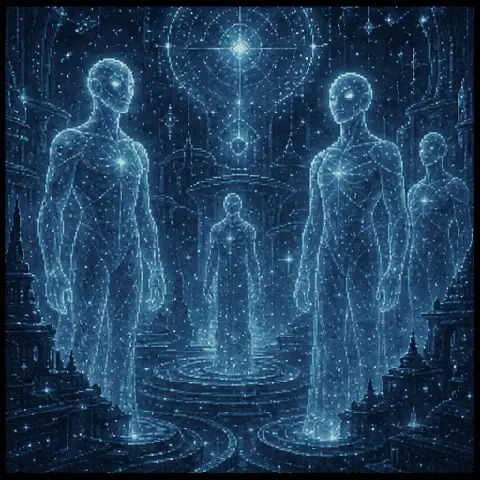
Machine elves are one named cluster within a broader category of DMT entity encounters. The defining feature is not pointy ears or a robotic body. It is the impression of meeting an autonomous intelligence in a rapidly changing, highly geometric environment.
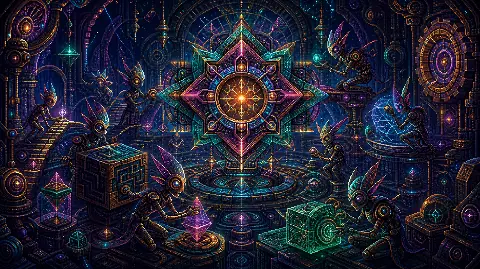
People commonly describe the entities as busy rather than passive. They build, sing, fold, perform, inspect, teach or present objects that seem to be made from colour, sound and language at once. The encounter often feels directed at the observer, as if the environment has noticed them.
"Machine elf" is not a scientific species, diagnosis or standard research category. Academic papers usually use terms such as entity, being or seemingly autonomous entity. The elf label belongs to psychedelic culture and to McKenna's account in particular.
Where The Name Came From
Terence McKenna popularised variants of "self-transforming machine elves" in books, lectures and recorded workshops. His entities were not fixed fantasy characters. He described rapidly changing forms that appeared to make objects, language and themselves through sound.
"Machine" captured their constructed, repetitive and self-assembling quality. "Elf" captured their small scale, speed, playfulness and trickster-like behaviour. McKenna also rearranged the phrase as "self-transforming elf machines", reinforcing that it was an improvised description rather than a formal taxonomy.
The shorter label later expanded online. It can now refer to almost any intelligent-looking DMT entity, including figures that other experiencers call jesters, guides, mantids, aliens or deities. That drift blurs a specific McKenna image with a much more varied body of reports.
What People Report Seeing
Machine elf accounts combine figure, setting and behaviour. Removing any one of those elements can change the encounter completely.
| Feature | Recurring Description | Variation |
|---|---|---|
| Form | Small humanoids, jointed figures, masks, toys, geometric bodies or animated symbols | Some reports contain no separate body at all. The room or pattern itself seems alive. |
| Movement | Rapid folding, building, dancing, transforming, multiplying or passing objects | Other entities remain still and communicate through gaze or presence. |
| Setting | Workshops, nurseries, circuses, domes, tunnels and jewel-like geometric rooms | The environment may replace ordinary depth, scale and direction. |
| Communication | Telepathic meaning, visual demonstration, sound, song or language-like objects | Clear spoken sentences are less central than immediate, non-verbal understanding. |
| Tone | Playful, welcoming, amused, instructive or intensely focused | Fear, hostility, indifference and clinical examination also appear in entity reports. |
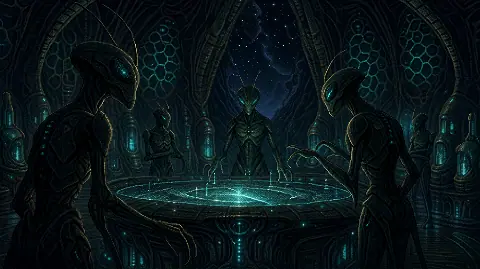
The reports overlap with folklore, artificial intelligence, childhood toy imagery and alien-contact narratives. They also overlap with insectoid and mantid entities, especially when an encounter feels technical, clinical or organised around a task.
What The Largest Entity Survey Found
A 2020 Johns Hopkins-led survey analysed 2,561 people describing their single most memorable encounter with a seemingly autonomous entity after smoking or vaporising a breakthrough dose of N,N-dimethyltryptamine.
| Survey Finding | Respondents |
|---|---|
| Encounter involved vision | 92% |
| Encounter involved an extrasensory mode such as telepathy | 85% |
| Some form of communication occurred | 84% |
| Experience still felt more real than everyday waking consciousness | 65% |
| Entity was rated conscious and intelligent | 96% for each attribute |
| Entity was believed to continue existing after the encounter | 72% |
| Experience altered the respondent's fundamental conception of reality | 80% |
Those percentages describe selected entity experiencers, not all DMT users. Eligibility required participants to have already encountered a seemingly autonomous being. The study therefore cannot show how often a random user sees an entity, and it certainly does not show that 96% of DMT users meet conscious beings.
The results do show why the phenomenon is so durable. Only 21% entered intending to meet an entity, while 69% said the entity initiated the encounter. Forty-one per cent reported fear, yet love, kindness and joy were among the most prominent emotions. The combination of surprise, agency and emotional intensity can make the event difficult to dismiss as ordinary imagination.
Do All DMT Entities Look Like Machine Elves?
No. In a naturalistic field study based on 36 post-experience interviews, 34 participants described an encounter with a being or presence. The reported forms included human figures, animals, non-human creatures, sensed presences and sentient structures. Helping, showing, communing, manipulation and control all appeared as entity roles.
A separate phenomenology study identified feminine figures, deities, aliens, animals, reptilian and insectoid beings, mythological figures including machine elves, and jesters. The machine elf is one recognisable motif inside a much larger encounter ecology.
Both studies have limits. Their samples were small or self-selected, participants were mostly experienced users, and the reports were collected after the event. They document recurring content. They do not establish a universal DMT realm or a fixed population of beings.
Why Do The Entities Feel Autonomous?
Three features make these encounters feel separate from the self. The entity appears to initiate action, it responds to attention, and it communicates information the experiencer does not feel they deliberately created.
Human perception is already specialised for finding agents, faces, intentions and social meaning. Under a radically altered state, those systems may organise unstable visual and emotional material into an apparently independent character. A responsive entity can then feel more convincing than a passive hallucinated object.
Expectation may influence the form without fully explaining the event. Someone familiar with McKenna may recognise a fast geometric figure as a machine elf. Someone using different cultural language may call a similar presence an ancestor, spirit, alien, deity or jester. Most entity studies do not measure prior familiarity with each label closely enough to separate shared neurobiology from cultural priming.
What Brain Imaging Can Tell Us
In a placebo-controlled study of 20 healthy volunteers, researchers used EEG and functional MRI before, during and after intravenous DMT. They found increased communication across brain regions, reduced separation between established networks and marked disruption in systems associated with high-level modelling.
One interpretation is that the brain's usual predictions about self, space and sensory input lose stability. Incoming and internally generated material may then be experienced with unusual vividness and less of the ordinary signal that says, "I made this." That provides a plausible route to living geometry, impossible rooms and autonomous social agents.
The scans did not detect machine elves. No published brain signature uniquely identifies an entity encounter, and no external signal was measured alongside one. Neuroscience can track the altered conditions in which an encounter occurs without deciding the entity's ultimate origin.
Four Explanations For The Same Encounter
| Model | What It Explains | What Remains Unresolved |
|---|---|---|
| Neurocognitive agent | Agency detection, social cognition and disrupted predictive processing generate an apparently independent being. | Why some motifs and interaction styles recur across different people. |
| Cultural template | McKenna, online trip reports, folklore and alien imagery shape expectation, vocabulary and memory. | Experiences reported without conscious expectation and the intensity of perceived autonomy. |
| Archetypal form | Shared human cognitive and mythic patterns produce guides, tricksters, builders and watchers. | An archetype describes recurrence but does not identify a mechanism by itself. |
| External intelligence | The entity feels independent because it is interpreted as an actual mind in another reality. | No verified external signal, testable location or independently recoverable information establishes that claim. |
The first three models can overlap. A shared cognitive tendency may be shaped by culture and expressed through old trickster imagery. The external-intelligence model matches many experiencers' interpretation, but it currently has the least independently testable evidence.
Are Machine Elves Aliens?
Machine elves feel alien, but there is no evidence that they are extraterrestrials in the physical sense. A classic Grey alien report begins with an alleged visitor, craft or abduction in ordinary space. A machine elf report begins after a powerful change in consciousness.
The categories meet around non-verbal contact. Both DMT entities and alien encounters are often described through telepathic communication, immediate knowing and the impression that a message arrived from somewhere else. Similar language does not prove a shared source.
Interdimensional and simulation-based explanations remain philosophical possibilities rather than demonstrated findings. No machine elf account has produced a repeatable signal, instrument record or independently verified message that requires an external intelligence.
The Reality Claim And Its Risks
An encounter can be psychologically consequential without being externally real. Sixty-five per cent of respondents in the large survey still rated their experience as more real than everyday consciousness, and 80% said it changed their fundamental conception of reality. That is a clear route to ontological shock.
DMT is also a potent psychedelic, not a neutral observation tool. Australia's Alcohol and Drug Foundation lists intense hallucinations, anxiety, confusion, dissociation, increased heart rate and increased blood pressure among its effects. It can worsen symptoms for some people with current or previous mental health concerns.
A frightening or persistent experience should be treated as a health concern, not as proof that an entity has attached itself to the witness. Ongoing distress, paranoia or difficulty functioning warrants professional support.
What The Evidence Supports
Machine elves are a culturally stable name for one recurring cluster of DMT entity reports. The evidence supports intense visual encounters, perceived communication, strong attribution of consciousness and lasting changes in worldview among selected experiencers.
The evidence does not establish a separate species, an interdimensional civilisation or an intelligence independent of the brain. The unresolved question is narrower and more interesting. Why can a brief altered state generate an encounter that behaves like a social event, feels more real than waking life and continues to reorganise belief after the drug has worn off?
The Machine Elf NFT model translates that mix of fog, geometry and benevolent strangeness into the Other Worlders pixel collection.
Source Trail
- Terence McKenna: Time And Mind workshop transcript
- Journal of Psychopharmacology: Survey of DMT entity encounter experiences
- Frontiers in Psychology: An Encounter With The Other
- Scientific Reports: Phenomenology and content of the inhaled DMT experience
- Imperial College London: DMT EEG and fMRI study
- Alcohol and Drug Foundation: DMT facts, effects and risks