The Case In One Minute
| Case Detail | Public Record |
|---|---|
| Main dates | 19-20 July and 26-27 July 1952 |
| Primary locations | Washington National Airport, Andrews Air Force Base and the surrounding capital airspace |
| Evidence types | Air traffic radar reports, military radar reports, pilot observations, ground observations and Air Force records |
| Reported appearance | Mostly white, orange or red-yellow lights rather than clearly described structured craft |
| Military response | F-94 Starfire interceptors were dispatched from New Castle Air Force Base in Delaware |
| Official explanation | Atmospheric effects on radar, combined with misidentified stars, meteors and other ordinary lights |
| Unresolved point | The surviving record does not cleanly connect every visual observation to a verified radar target |
The incident is often called the Washington flap or Washington merry-go-round. It occurred during a much larger 1952 wave of UFO reports, only months after the Air Force renamed its investigation Project Blue Book.
The First Weekend: 19-20 July 1952
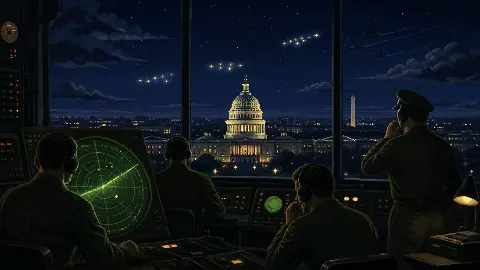
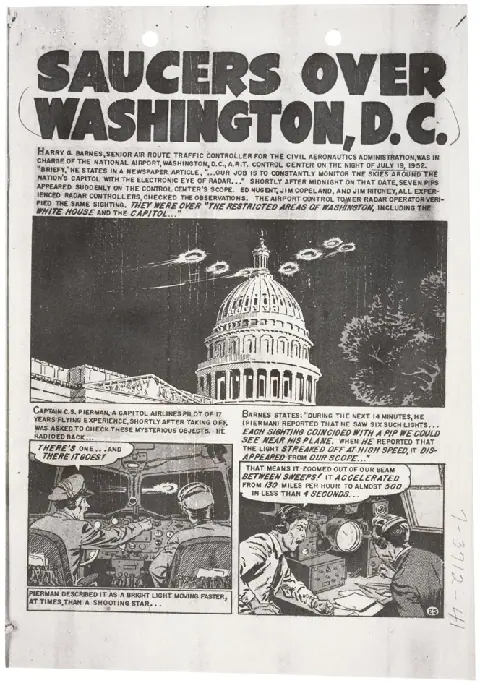
At about 11:40 pm on 19 July, air traffic controller Edward Nugent reportedly noticed seven unusual returns on the Air Route Traffic Control radar at Washington National Airport. His supervisor, Harry Barnes, and other controllers joined him as the targets separated and moved across the scope.
The National Airport control tower and Andrews Air Force Base were contacted as the event developed. Accounts from the period describe returns on more than one radar system, although the surviving records do not provide a modern, synchronised sensor log showing that every scope tracked the same target at the same time.
Visual reports gave the event its radar-visual reputation. Capitol Airlines pilot S. C. Pierman reported bright lights while flying near Washington. Tower personnel also described an orange light. The descriptions concern luminous points with unusual apparent motion, not close views of metallic discs.
F-94 interceptors were sent from New Castle Air Force Base because the runway at Andrews was under repair. By the time the fighters reached the capital area, the stronger targets had reportedly disappeared. Some accounts say returns reappeared after the jets left, but no interceptor obtained a close identification.
The Second Weekend: 26-27 July 1952
The second weekend produced the most detailed surviving military summary. An Air Force report dated 11 August 1952 states that unidentified targets appeared on the Air Route Traffic Control Center and tower scopes at Washington National, and on approach-control radar at Andrews.
The report describes up to 12 targets on the main control-centre scope. Four initially moved in a rough line at less than 100 mph while eight were scattered elsewhere. Washington National's tower crew, however, positively classified only one return as unidentified. It crossed the scope from west to east at an estimated 30 to 40 mph.
At 10:46 pm, Civil Aeronautics Administration flight inspector Bill Schreve reported five glowing objects ranging from orange to white while flying at 2,200 feet. Commercial pilots also reported lights. Two F-94s launched at 11 pm and were directed towards radar returns, but the official summary says their results were generally negative.
One fighter pilot reportedly saw four lights and later a single light that went out before he could close on it. A B-25 crew received vectors towards several targets and observed that the directions repeatedly took them over busy roads or intersections. That detail supports the possibility that some visual reports involved ground lights while the radar scopes displayed unrelated anomalous returns.
The record is unusually candid about its own limits. The author had not received formal reports from the interceptor pilots, had not interviewed the commercial or CAA pilots, and wrote that it had been impossible to collect all facts into one report.
What The Radar Evidence Shows
Three radar settings appear in the case, but they did not produce one continuous track. The main Washington National control centre used a VG-2 radar. The airport tower used an ASR-1. Andrews operated its own approach-control radar.
The second-weekend report distinguishes between strong, aircraft-like returns and dim, unstable returns. Air Force and Navy officers Dewey Fournet and John Holcomb arrived at the control centre after midnight. Holcomb reportedly observed seven solid targets and initially doubted that the slight surface inversion explained them. Later in the night, the same observers saw weaker unstable returns that they did attribute to the inversion.
Claims that objects accelerated to thousands of miles per hour appear in later summaries of the case. Those figures depend on treating separated radar paints as a continuous physical track. Without complete raw plots, range data and synchronised records, the highest speed estimates are less secure than the basic fact that controllers reported unusual returns.
This distinction places Washington among the stronger historical documented UFO cases, but it does not turn incomplete radar data into proof of extraordinary aircraft.
What Witnesses Actually Described
The best-supported visual descriptions are lights. Pierman described bright, tailless lights. Schreve reported five glowing objects with colours from orange to white. Commercial pilots used descriptions such as a light or a cigarette-like red-yellow glow.
That record is different from the familiar image of silver saucers circling the Capitol. Contemporary illustrations supplied the discs. The witnesses mainly supplied points of light, apparent motion and uncertainty about distance.
A light without a reliable distance cannot yield a reliable size or speed. A star, meteor, aircraft light or reflection can seem to move when an observer, cloud layer or reference point shifts. The visual reports become stronger only where they can be matched convincingly to a radar return, and the surviving files do not establish that match in every instance.
What The F-94 Interceptors Found
The fighters confirmed that the reports were treated as an air-defence problem, but they did not confirm a craft. Two interceptor flights entered the Washington area on the second weekend. Controllers directed them towards targets, yet the jets either saw nothing or reported lights they could not identify.
The 11 August summary says one flight passed through a cluster of radar returns without seeing anything. By the time the second flight arrived, no strong targets remained and its vectors towards dim returns produced no result.
No aircraft was forced down, photographed at close range or tracked back to an origin point. No debris or physical trace came from either weekend. The intercept record supports a real military response to uncertain data, not a successful encounter with a verified vehicle.
The Temperature-Inversion Explanation
A temperature inversion occurs when warmer air sits above cooler air near the ground. Combined with a sharp change in humidity, that structure can bend radar energy and produce anomalous propagation. Ground objects, vehicles or distant structures may then appear as targets where no aircraft exists.
At the Pentagon press conference on 29 July, Major General John A. Samford presented atmospheric propagation and visual misidentification as the leading explanation. A later Civil Aeronautics Administration study found a recurring association between unidentified radar targets and surface inversions.
The University of Colorado's 1968 Condon Report revisited the Washington weather profiles. Its radar specialist concluded that conditions during the relevant period were conducive to anomalous propagation, that the radar returns were most likely produced by it, and that most visual objects were probably meteors or scintillating stars.
Does The Weather Explanation Cover The Whole Case?
Anomalous propagation explains several specific details. Returns were intermittent, some were slow or stationary, later targets were dim and unstable, and a B-25 crew found that radar vectors repeatedly pointed towards busy ground locations. The weather profiles also show that radar-bending layers were physically possible.
It does not automatically identify every visual light, and the second-weekend report separates returns officers considered solid from weaker echoes they readily blamed on the inversion. The case may contain several causes rather than one answer. Radar propagation, stars, meteors, aircraft, ground lights and genuinely unresolved observations can coexist during the same busy night.
The missing element is a complete evidence package. Modern analysis would need preserved radar plots, instrument settings, exact timestamps, aircraft tracks, weather measurements at matching times and independent visual bearings. The public file contains fragments of that information, not the full set.
Why Washington Changed The Government Response
The capital sightings arrived during a record wave of reports and forced the Air Force to answer questions about unknown targets near restricted airspace. The press conference and subsequent publicity made the case a national story rather than another entry in a military file.
The CIA also reviewed the wider 1952 UFO situation. Its concern was not limited to whether unusual craft existed. Officials feared that a flood of reports could overload air-warning channels, conceal a genuine attack or be exploited for psychological warfare. Those concerns helped lead to the CIA-sponsored Robertson Panel in January 1953.
The incident therefore changed policy even without establishing what every target was. It exposed a reporting and air-defence problem during the Cold War, influenced how officials communicated about UFOs, and became a fixed point in the wider UFO timeline.
What The Evidence Supports
The Washington incident involved real radar anomalies, real visual reports and real fighter scrambles across two July weekends. The official documents also contain uncertainty, incomplete follow-up and observations consistent with atmospheric effects and misidentified lights.
The record does not support the strongest popular version of a photographed fleet of solid saucers manoeuvring over the White House. It supports a complicated radar-visual event in which some reports received plausible ordinary explanations and others remained too incomplete for a confident identification.
That uncertainty is the durable part of the case. Washington was neither a single false radar blip nor a documented alien overflight. It was a cluster of observations produced by several people and systems under conditions that made both identification and exaggeration unusually easy.
Source Trail
- Department of the Air Force summary: Washington, D.C., night of 26-27 July 1952
- National Archives: Saucers Over Washington and the history of Project Blue Book
- National Archives: Project Blue Book in the film record
- National Archives: Project BLUE BOOK records and Air Force fact sheet
- Civil Aeronautics Administration: Preliminary study of unidentified air traffic radar targets
- Condon Report: Optical and radar analysis of the Washington incidents
- CIA: How to investigate a flying saucer and the Robertson Panel context