What Happened Over Stralsund On 8 April 1665?
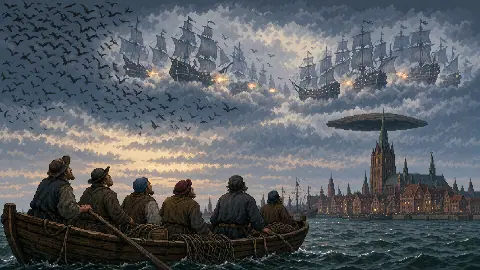
The earliest detailed narrative begins at about 2 p.m. Six fishermen were anchored near Barhöft while fishing for herring off the Baltic coast. They reportedly saw a large flock of birds arrive from the north-east, circle, condense into a clump and stretch into a form compared with a long corridor. The shape then appeared to become a large ship.
More ships followed until, according to the pamphlet, they could not be counted. A southern fleet approached, smoke obscured the scene and the two sides exchanged fire with reports as loud as heavy guns. Fleets then arrived from the west and east. The fishermen claimed they could see damaged masts, flags, crews moving on deck and a dark-clothed man holding his hat beneath his right arm.
At about 6 p.m. the northern fleet disappeared while the southern fleet remained. Soon afterwards, a round flat form appeared above St Nicholas Church. The text compared it with both a plate and a large man's hat, with colouring like an eclipsed moon. It reportedly remained until evening. The fishermen withdrew in fear and later experienced trembling and pain.
The case now appears in lists of historical UFO incidents, but the label is retrospective. The 1665 printers described a wonder sign and an omen, not an extraterrestrial vehicle. The wider ancient UFO sightings and historical sky phenomena archive shows how fleets, chariots and divine warnings supplied the vocabulary before the modern flying-saucer era.
The Six Fishermen Named In The Report
The publications name Asmus Barfod, Claus Sinnenman, Jochim Hasse, Hans Trebus, Michel Rode and Stephan Rode. Spellings differ in modern catalogues and transcriptions, but the six-name group remains stable. Naming alleged witnesses made the report more concrete than an anonymous wonder tale.
The illustrated broadsheet says the men were known citizens of Stralsund and had testified with a clear conscience during a public examination. No transcript of that examination, signed statement or municipal case file accompanies the surviving print. The claim that they were formally questioned therefore comes from the publication selling the story.
The six men also shared one boat and one viewing environment. They were a witness group, not six independent observation stations. The report does not preserve separate accounts showing which man saw each detail or whether their descriptions agreed before the narrative was combined.
A Timeline Of The Stralsund Source Trail
| Date | Source Or Event | What It Adds |
|---|---|---|
| 8 Apr 1665 | Alleged observation | Fishermen reportedly watched aerial fleets from about 2 p.m., then a dark plate-like form above St Nicholas Church towards evening. |
| 10 Apr 1665 | Stralsund pamphlet | The earliest detailed surviving account appeared two days later and supplied the names, sequence and plate comparison. |
| Within days | Einkommende Ordinari und Postzeitungen | A newspaper version reported the event but omitted both the initial clump and the later disc. |
| Later in 1665 | Leipzig illustrated broadsheet | The first known image compressed the full sequence into one labelled scene and rendered the disc as a moon face. |
| 1670 | Lightning struck St Nicholas Church | The altar exploded and nine people were injured, allowing later writers to reinterpret the 1665 disc as a warning. |
| 1671 to 1679 | Historical works and reprints | The report was tied to successive European wars and repeated without new witness evidence. |
| 1680 | Erasmus Francisci and Johann Alexander Boner | The famous engraving appeared 15 years later, based on collected second and third-hand sources. |
| 1689 | Relationes Curiosae | A reversed tracing of the 1680 engraving gave the story its third and final early-modern image. |
| 2023 | Berlin Kunstbibliothek exhibition | Museum researchers reconstructed how the report changed across pamphlets, newspapers and engravings. |
The timeline separates proximity from repetition. A source printed in the same week is not equivalent to an engraving made 15 years later. Ten publications can also descend from one early text without creating ten independent witnesses.
The First Pamphlet Appeared Two Days Later
The German Weather Service digital library preserves the 10 April pamphlet, titled Gründliche Relation. Its survival is the case's strongest documentary feature. The document was printed in Stralsund only two days after the alleged observation and runs to two unnumbered leaves.
Speed reduces the opportunity for a story to drift across generations, but it does not verify the event. The pamphlet does not identify its author, printer or reporting method. It presents a polished collective sequence, includes political and religious interpretation, and ends by asking what new disaster an angered God might pour over the Baltic region.
The text also supplies details that later authors copied almost word for word. The bird flock becoming a clump, the corridor shape, the dark man on deck and the plate above St Nicholas recur because writers reused the pamphlet. Repetition here often maps textual inheritance rather than independent corroboration.
The Earliest Image Was A Simultaneous Reconstruction
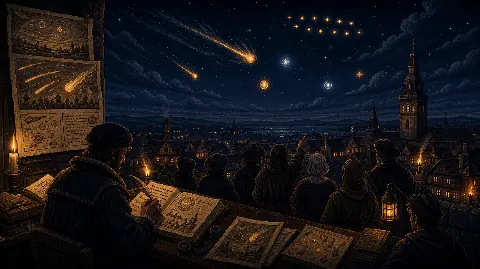
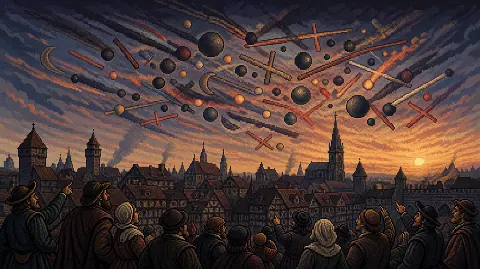
A separate illustrated broadsheet was published in Leipzig later in 1665. It is the earliest known visual report, but it is not a view captured at one moment. Letters guide the reader through consecutive phases placed together in one scene: birds, fleets from four directions, fishermen, smoke, ships and the form above the church.

The picture is therefore evidence for how the story was packaged in 1665, not direct visual evidence of ships in the sky. Its caption interprets the event as a warning of war around the Baltic. The image and text were designed to turn a reported spectacle into a readable political and religious message.
The Separate Newspaper Leaves Out The Disc
The Berlin State Museums exhibition identified an issue of Einkommende Ordinari und Postzeitungen that covered the event within days. Its correspondent apparently worked from a different source chain. The report does not mention the initial clump or the plate-like form above St Nicholas Church.
That omission is more informative than another copied description. It shows that the most recognisable elements were not stable across the earliest reporting. The newspaper may have received an incomplete account, or the Stralsund pamphlet may have added details unavailable to the correspondent. The surviving documents cannot decide between those possibilities.
The newspaper is not a second instrument reading. It still reports a story through a seventeenth-century communications network. It does, however, prevent the later, fuller narrative from being treated as the only version circulating close to the alleged event.
The Famous Engraving Was Made 15 Years Later
The image most often reproduced today comes from Erasmus Francisci's 1680 book Der Wunder-reiche Uberzug unserer Nider-Welt. Francisci acknowledged that he was relying on second and third-hand sources. Nuremberg engraver Johann Alexander Böner produced the illustration from the material Francisci collected.
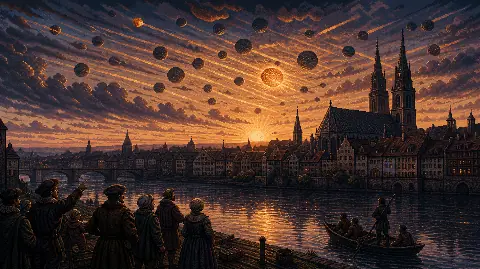
The composition creates false immediacy. The fishermen who were supposedly at sea are placed on dry land in the foreground, at the viewer's eye level. Their bodies guide the audience towards the fleets and disc, making the print resemble an eyewitness panorama rather than a reconstruction assembled 15 years later.
The same problem appears in other early-modern cases. The famous image attached to the Nuremberg sky phenomenon is a theological broadsheet, while the Basel celestial phenomenon combines several dates into one illustrated warning. Authentic old pictures can still be editorial objects.
How The Dark Disc Changed Across The Images
| Source | Disc Treatment | Evidential Consequence |
|---|---|---|
| 10 April pamphlet | Described as a round, flat plate or large hat, coloured like an eclipsed moon. | Early text, but no measurement, drawing or separate witness statement. |
| Early newspaper | Not mentioned. | The disc was not stable across the first reports. |
| 1665 Leipzig broadsheet | Small moon-like face above the church. | The artist interpreted the eclipse comparison literally rather than drawing a plate. |
| 1680 Francisci engraving | A more compact dark clump hangs above St Nicholas. | The later image better resembles a modern saucer, but is farther from the alleged event. |
| 1689 Relationes Curiosae | The 1680 scene is traced and printed in reverse. | A copied image can look like a separate historical depiction. |
The disc became visually clearer as the source distance increased. That direction is the opposite of what an evidential chain should do. Later artists resolved ambiguity through design, while modern UFO books inherited the sharper image without always preserving its publication history.
Why A 1670 Lightning Strike Reframed The Story
On 19 June 1670, lightning struck St Nicholas Church during a Sunday sermon. The altar exploded and flying debris injured nine people. Later writers connected the disaster to the plate-like form reportedly positioned above the same church five years earlier.
Francisci treated the strike as the fulfilment of a warning. In this reading, Stralsund had received a sign, failed to repent and was punished at the marked location. The 1679 reprint joined the 1665 apparition and the 1670 church event in one wonder-sign narrative.
This was retrospective pattern building. The lightning strike did not independently verify an object above the church in 1665. It gave a previously ambiguous shape a role, then encouraged artists to make that shape more coherent and ominous.
Could A Fata Morgana Explain The Aerial Fleets?
A superior mirage can bend light through layers of air with different temperatures, making ships below the horizon appear elevated, stretched, duplicated or inverted. The NOAA Coast Pilot describes ships appearing to float above their true position. Over a cold Baltic sea, distorted distant vessels are a physically credible candidate.
The Berlin museum project considered a Fata Morgana of a naval exercise or sea battle. Its researchers did not find a matching maritime event. The proposal also has to explain a long sequence involving fleets from four directions, gunfire, detailed crews and a separate form aligned with a city church.
A mirage could account for the core image of ships suspended in the sky without reproducing every printed detail. The same caution applies in reverse. Missing weather observations and ship records prevent a specific mirage reconstruction, so possibility should not be presented as a solved case.
Testing Four Explanations Against The Record
| Explanation | What It Can Explain | What It Leaves Open |
|---|---|---|
| Bird flock | The report begins with many birds circling, clustering and changing apparent shape. | Ships, smoke, cannon reports, crews and the later disc. |
| Superior mirage | Distant ships appearing raised, enlarged, multiplied or distorted above the horizon. | No matching fleet has been identified and the church-aligned form appears later. |
| Sailor's yarn or hoax | The polished sequence, political symbolism, absent testimony and commercial wonder-print market. | A pamphlet appeared quickly, named six local men and claimed public questioning. |
| Composite event | Birds, distant vessels, unusual refraction, sound and later editorial construction contributing different details. | The surviving record is too sparse to assign each feature to a verified cause. |
The reported physical symptoms do not separate the options. Trembling and pain appear in the pamphlet without a medical record, examination date or diagnosis. Fear, cold exposure and narrative symbolism remain at least as plausible as an unknown radiation effect.
The case also illustrates the psychosocial UFO hypothesis without reducing the fishermen to liars. An ambiguous stimulus can be sincerely observed, interpreted through familiar war and religious imagery, then sharpened as publishers compete to explain it.
What The Stralsund Case Actually Establishes
Something was reported near Stralsund in April 1665, and a detailed pamphlet entered print two days later. The publication named six men, fixed the observation to a place and time, and supplied a sequence vivid enough to survive through later histories and engravings.
The archive does not establish literal warships flying through the atmosphere. It contains no direct testimony, weather data, ship log, physical trace or image made from observation. Even the plate-like form is absent from one early newspaper report and changes across the surviving illustrations.
Stralsund is best understood as two linked mysteries. The first is the stimulus, which may have involved birds, ships, refraction or invention. The second is the transformation of that report into a visual UFO case. The documents preserve the second process in unusual detail, while leaving the first unresolved.
Source Trail
- German Weather Service Digital Library: Gründliche Relation, Stralsund, 10 April 1665
- Wikisource and Herzog August Library: transcribed 1665 illustrated broadsheet
- Staatliche Museen zu Berlin: A UFO in 1665, The Air Battle of Stralsund
- Berlin Kunstbibliothek: bilingual exhibition texts and object notes
- Moritz Wullen: UFO 1665 catalogue extract
- Rijksmuseum Research Library: UFO 1665 catalogue record