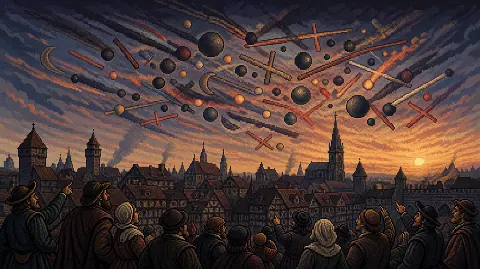
Ancient UFO Sightings At A Glance
| Date | Place | Surviving Record | What It Describes | Main Evidential Limit |
|---|---|---|---|---|
| 218 BCE | Roman Republic | Livy, History of Rome 21.62 | A "phantom navy" shining in the sky | Written roughly two centuries after the reported event inside a prodigy list |
| 74 BCE | Phrygia | Plutarch, Life of Lucullus | A flaming, silver object falling between two armies | Written more than a century later |
| 66 CE | Judea | Josephus, The Jewish War | Chariots and armed troops moving among clouds | Presented as an omen before Jerusalem's destruction |
| 1561 | Nuremberg | Hans Glaser broadsheet | Crosses, spheres, rods and a dark form around the rising sun | A moralising illustrated news sheet, not an observational diagram |
| 1566 | Basel | Samuel Coccius and Samuel Apiarius broadsheet | Red skies and black or fiery balls over several dates | Several events were combined into one religious interpretation |
| 1609 | Gangwon Province | Journal of Gwanghaegun | Noisy, luminous objects reported from several locations | Official compilation of local reports without physical evidence |
| 1639 | Massachusetts Bay | John Winthrop's journal | A moving light watched from a boat on the Muddy River | Winthrop recorded another man's account |
| 1665 | Stralsund | Broadsheets and newspapers | Birds becoming warships, an aerial battle and a dark disc | Competing print versions transformed the story |
| 1896 | California | Contemporary newspapers | Moving lights, airships, machinery and alleged occupants | Hoaxes and copied stories spread with the reports |
This is not a ranking of the oldest alien encounters. It is a map of records that are now described as ancient or historical UFO sightings. The date in the first column belongs to the alleged event. The source may have been created days, decades or centuries later.
What Counts As An Ancient UFO Sighting?
A historical report enters the UFO archive when it describes something in the sky that the surviving text does not identify. That is the same limited meaning used on the What Is A UFO? page. Unidentified does not mean extraterrestrial.
Applying the label to a pre-modern account is retrospective. Roman authors wrote about prodigies. Early modern printers sold accounts of wonders and divine warnings. Colonial diarists recorded providences. Nineteenth-century editors reported mystery airships. None of those writers used the modern UFO category.
A document can be authentic while the event inside it remains uncertain. The physical broadsheet may be genuine, yet its picture may be symbolic. A chronicle may preserve a real report without preserving a direct witness statement. A detailed description may still fit a meteor, halo, aurora, bird flock, rumour or deliberate invention.
That distinction separates this archive from a simple list of UFO sightings. The object of study is not only the light or shape in the sky. It is the complete chain from observation to record to modern interpretation.
Roman Sky Reports Were Written As Portents
Livy's Phantom Fleet In 218 BCE
The oldest case in this timeline comes from Book 21 of Livy's History of Rome. During the tense opening of the Second Punic War, Livy records that a "phantom navy was seen shining in the sky". The 218 BCE ships in the sky have since been recast as a formation of structured craft.
The surrounding text changes that reading. Livy introduces the passage by saying that reports gained easy credence once people were stirred by religious fear. The same list includes a six-month-old child shouting a triumphal phrase, an ox climbing to an upper floor, a moving spear, a stone shower and a sword stolen by a wolf.
Livy was not filing an observation report. He was collecting prodigies associated with a national emergency, and he wrote roughly two centuries after the reported winter. The passage proves that a sky-fleet story entered Roman historical literature. It does not preserve enough information to identify an aerial object.
The Flaming Object Between Two Armies In 74 BCE
Plutarch's Life of Lucullus contains a more physically specific scene. As Roman and Pontic forces prepared to fight near Otryae, a flame-like body reportedly fell between them. Plutarch compared its shape to a wine jar and its colour to molten silver. Both armies withdrew.
A bright meteor or bolide is an obvious candidate because the text describes a luminous body descending suddenly. It is not a complete solution. No trajectory, duration, impact site or recovered material survives, and Plutarch wrote more than a century after the campaign. The description is striking, but the data are thin.
The Sky Army Over Judea In 66 CE
Josephus describes chariots and armoured troops moving among the clouds before the First Jewish-Roman War. The event is often dated to 65 or 66 CE, which explains the title of the local Sky Army report.
The Jewish War was completed within roughly a decade of the revolt, much closer to the event than Livy or Plutarch. Josephus still places the scene inside a sequence of warnings that foreshadow Jerusalem's destruction. He even calls the phenomenon prodigious and difficult to believe.
An aurora, unusual cloud illumination or literary omen motif could produce martial imagery. The text does not let us choose confidently between them. Its strongest contribution is evidence that a sky-army claim circulated close to the war, not evidence of machines hidden inside the clouds.
Broadsheets Turned The Sky Into A Battlefield
Nuremberg In 1561
Hans Glaser's coloured broadsheet is the image most often presented as a sixteenth-century UFO battle. The surviving print describes a spectacle around sunrise on 14 April 1561. Its woodcut shows the sun surrounded by crosses, coloured spheres, rods and a large black form, with shapes falling towards the ground.
The Zentralbibliothek Zurich holds the digitised original and identifies it as a single-sheet print made by Glaser in Nuremberg in 1561. That close publication date is a genuine strength. The weakness is genre. Glaser's text treats the display as a warning from God and urges repentance.
The image on the Nuremberg 1561 case file is not a photograph, map or frame-by-frame record. It compresses a reported sequence into one theological news image. Halo phenomena and sun dogs can create bright spots, arcs and crosses around a low sun, but no reconstruction has matched every element in the broadsheet.
Basel In 1566
The Basel broadsheet is often reduced to black spheres fighting over the city. The actual narrative covers several dates. It describes an unusually red sunset on 27 July, a lunar eclipse and red dawn on 28 July, then black and fiery circular forms around the sun on 7 August.
The Swiss National Museum's account places the print inside the religious and political tension of Reformation-era Europe. Samuel Coccius interpreted the display as a call for repentance, while printers Samuel Apiarius and Samuel Coccius turned it into a compact illustrated leaflet.
The Basel 1566 case may combine atmospheric optics, unusual sunlight, the eclipse and editorial design. Black circles crossing the sun could also describe birds seen in silhouette. None of those proposals has been demonstrated as a complete explanation, and the source does not contain the measurements needed to run a decisive reconstruction.
Official Records Can Still Preserve Uncertainty
The Gangwon Reports In 1609
The 1609 Gangwon sky phenomenon survives in the Journal of Gwanghaegun, part of Korea's royal annal tradition. Reports from several locations describe a luminous or bowl-like object, movement across the sky and loud sound over a period of hours.
This record differs from a European religious broadsheet because provincial observations entered an official administrative archive. That does not turn every description into an independent instrument reading. Local reports were gathered, phrased and compiled before reaching the surviving record.
A bright bolide crossing a large region can produce changing shapes, fragmentation and delayed booms. The extended timing in some translations complicates a single-fireball explanation. The case remains historically well documented but physically underdetermined.
The Muddy River Light Recorded In 1639
John Winthrop recorded that James Everell and two companions saw a great light while rowing on the Muddy River. The light reportedly flared when stationary, contracted into a shape compared with a swine when moving, and travelled quickly between the observers and Charlestown. The men later found themselves upstream, which Winthrop attributed to the tide.
The 1639 great light is regularly called America's first UFO sighting. More precisely, it is an early colonial journal entry about a secondhand nocturnal light report. Winthrop did not witness it, no exact observational geometry survives and the familiar 1 March 1639 date refers to his journal entry rather than a clearly established night of observation.
Marsh gas, an astronomical object, unusual refraction and narrative embellishment have all been proposed. Each explains only part of the account. The honest conclusion is unresolved through missing data, not confirmed through extraordinary behaviour.
The Stralsund Media Event In 1665
On 8 April 1665, six fishermen near Stralsund reportedly watched bird flocks become warships that fought in the sky. Later they saw a dark, plate-like form above St Nikolai church. Printed versions added ghostly crews, cannon fire and physical illness the next day.
The Staatliche Museen zu Berlin reconstructed the story's media history from contemporary images and texts. Its exhibition found that broadsheets and newspapers competed with different versions and religious readings. Later illustrations made the dark disc more visually prominent.
Stralsund is therefore unusually informative even if the object remains unidentified. The archive captures report mutation in action. Witness claim, print competition, theological interpretation and later UFO imagery did not arrive as one stable package.
The Mystery Airships Changed The Vocabulary
In November 1896, California newspapers began reporting moving lights and alleged airships. As the story spread, reports acquired searchlights, propellers, cabins, pilots, inventors and conversations with occupants. The California mystery airship wave arrived seven years before the Wright brothers' powered aeroplane flight, but after decades of balloon and dirigible experiments.
The language was technologically current. Roman writers reached for fleets and chariots. Early modern printers pictured divine signs and aerial armies. Newspaper witnesses and editors at the end of the nineteenth century described a secret invention.
The archive is substantial because papers such as the San Francisco Call survive in the Library of Congress. Its size does not make every story reliable. Editors copied reports, anonymous inventors supplied convenient explanations and acknowledged hoaxes travelled beside sincere observations.
The wave demonstrates a limit of raw report counts. One original light can generate multiple articles, follow-up claims and imitative sightings. Without tracing publication dates and repeated wording, a long list can make a media cascade look like independent corroboration.
Natural Events Behind Historical Sky Reports
| Candidate | Features It Can Explain | Features That Need More Evidence |
|---|---|---|
| Sun dogs and halos | Bright spots, crosses, arcs and mock suns around a low sun | Objects travelling far from the sun, long duration or reported impact |
| Fireballs and bolides | Fast luminous bodies, fragmentation, trails and delayed explosive sound | Hours of movement, repeated return or stable formations |
| Aurora | Large red, green or pale displays, curtains, rays and apparent aerial motion | Compact solid forms or a short local trajectory |
| Comets | Bright heads, tails and an appearance sustained across many nights | Rapid manoeuvres or sudden nearby sound |
| Birds or insects | Dark spheres, changing formations and silhouettes crossing the sun | Intense light, explosive sound or a distant multi-region track |
| Print embellishment | Escalating details, symbolic shapes and copied witness language | An independently dated observation from another source |
The US National Weather Service explains that halos and sun dogs form when light meets ice crystals, often placing bright forms at fixed angles around the sun. NASA defines fireballs and bolides as unusually bright meteors that may fragment in the atmosphere. Those mechanisms establish plausible candidates, not automatic solutions.
A proposed explanation has to fit the full record. Calling every luminous object a meteor is no stronger than calling every luminous object a spacecraft. Duration, direction, angular relationship to the sun, sound delay, weather, source date and independent observations decide whether the match holds.
How To Test A Historical UFO Claim
- Date the document. Separate the alleged event date from the date of the earliest surviving source. Livy's two-century gap is not equivalent to Glaser printing in the same month.
- Identify the genre. A royal annal, battlefield biography, omen list, sermon-like broadsheet and commercial newspaper were produced for different reasons.
- Inspect the original wording. Check whether "ship", "shield", "disc" or "chariot" appears in the source language, in one translator's choice or only in a modern summary.
- Look for independent records. Two papers copying one dispatch are one source chain. Stronger corroboration comes from separate locations, authors and publication routes.
- Test ordinary mechanisms against every detail. Use astronomy, weather, geography and timing. Mark the result unresolved when the historical data cannot discriminate between candidates.
This method also guards against the opposite error. A natural explanation should not be called proven merely because it is possible. The evidence standard applies to halo, meteor, hoax and extraterrestrial claims alike.
What The Historical Record Can Show
People reported strange objects and lights long before the modern flying-saucer era began in 1947. The reports are real historical material. They preserve fear, wonder, observation, politics, religion and media behaviour across more than two thousand years.
They do not provide an unbroken technical description of one phenomenon. The nouns change with the surrounding world. Fleets and chariots appear in ancient war histories. Warning signs dominate Reformation broadsheets. Airships arrive when inventors and electrical technology dominate newspapers. That pattern is consistent with the psychosocial UFO hypothesis, although cultural framing does not identify every stimulus.
NASA astrophysicist Richard Stothers argued that conventional phenomena could be removed from classical reports while leaving a small puzzling residue resembling modern UFO categories. A later study of Julius Obsequens treated many Roman celestial prodigies as records of meteorites, fireballs and related phenomena embedded in political and religious literature. The disagreement is productive because both approaches begin with the ancient text rather than a modern illustration.
No case on this page establishes an extraterrestrial vehicle, manufactured components or occupants through physical evidence. Several remain unresolved because the surviving data are too sparse. An unresolved ancient report is a limit on historical knowledge, not a shortcut to a stronger conclusion.
Sources And Further Reading
- NASA GISS: Richard Stothers, Unidentified Flying Objects in Classical Antiquity
- Perseus Digital Library: Livy, History of Rome, Book 21.62
- Plutarch, Life of Lucullus 8.6
- Perseus Digital Library: Josephus, The Jewish War, Book 6.5
- Meteoritics and Planetary Science: Roman records of meteorites and celestial phenomena
- Open Library: John Winthrop's Journal, History of New England, 1630-1649
- Library of Congress: Early dirigibles in historical newspapers