The Case In One Minute
| Case Detail | What The Record Supports |
|---|---|
| Traditional date | 74 BCE, although a revised campaign chronology places the sequence in 73 BCE |
| Location | Otryae in Phrygia, in western Anatolia |
| Opposing forces | The Roman army of Lucius Licinius Lucullus and forces serving Mithridates VI of Pontus |
| Surviving source | Plutarch, Life of Lucullus 8.5 to 8.7 |
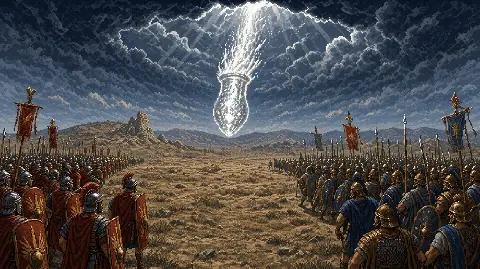
| Reported object | A huge flame-like body, shaped like a wine jar and coloured like molten silver |
| Reported outcome | It appeared to fall between the armies and both sides separated in fear |
| Strongest natural candidate | A bright meteor or fireball |
| Main evidence limit | One non-contemporary literary account with no named witness, physical trace or independent observation record |
The old version of this story was often dated to 76 BCE and said the object rose back into the sky. Neither detail appears in Plutarch's account. The commonly cited ancient source describes a fall between the armies, followed by their withdrawal.
What Plutarch Actually Wrote
The episode appears in sections 8.5 to 8.7 of Plutarch's Life of Lucullus. Lucullus had led out his troops after being challenged to fight. With the armies close to engagement and no preceding change in the weather, Plutarch says the sky suddenly seemed to open.
"A huge, flame-like body was seen to fall between the two armies."
The Loeb translation of Plutarch then compares the object's form to a wine jar and its colour to molten silver. Both armies were reportedly astonished by the sight and withdrew. Plutarch locates the event at Otryae in Phrygia.
| Plutarch Says | Plutarch Does Not Say |
|---|---|
| A flame-like body appeared suddenly | That it was a metal craft |
| It seemed to fall between the armies | That anyone found an impact site |
| Its shape resembled a wine jar | That it was literally a jar or container |
| Its colour resembled molten silver | That it was made from silver |
| Both armies separated | That the object hovered, changed course or flew away |
The distinctions remove several details added by modern summaries. There is no ascent, no landing inspection, no occupant and no recovered material. Even the apparent fall "between" the armies comes from ground-level perspective rather than a measured trajectory.
The Armies At Otryae
The setting was the opening phase of the Third Mithridatic War, fought between the Roman Republic and Mithridates VI of Pontus. Lucullus commanded a Roman force in Asia Minor. Plutarch gives him 30,000 infantry and 2,500 cavalry at this stage of the campaign.
Mithridates' much larger army had moved west after the king of Bithynia left his kingdom to Rome. In Plutarch's sequence, a commander named Marius, sent by the Roman rebel Sertorius to assist Mithridates, pressed Lucullus to fight. Lucullus initially preferred to delay because local people warned him that the battlefield favoured enemy cavalry.
The sky event stopped the immediate engagement, but it was not the strategic reason Lucullus avoided a major battle. Plutarch says he later calculated that Mithridates' huge army could not remain supplied for long. He chose to wait and soon trapped the Pontic force around Cyzicus by attacking its food and communications rather than its strongest formation.
This context changes the popular "meteor ended a battle" headline. No battle was under way when the object appeared. The armies were preparing to engage, then separated. Lucullus' later decision to avoid battle was presented as military calculation.
Why The Date Is Usually Given As 74 BCE
The surviving passage does not provide a day, month or Roman consular date. The 74 BCE label comes from the traditional chronology of Lucullus' campaign and from modern editions that place the surrounding events in that year.
There is a genuine chronological dispute. An Oxford history of Mithridates VI dates the opening of the final war and the Cyzicus campaign to 73 BCE. The revision is partly based on evidence that Lucullus was still in Rome late in 74 BCE. Because Plutarch places Otryae immediately before the move to Cyzicus, the flaming-object episode would also shift into 73 BCE under that reconstruction.
The title retains 74 BCE because it is the date attached to the best-known edition and most retellings. It should be read as a traditional campaign date, not a timestamp preserved by an eyewitness. The older 76 BCE date has no clear basis in the passage.
Why A Meteor Is The Strongest Explanation
A bright meteor, often called a fireball, fits the core description without requiring details absent from the text. NASA defines a fireball as a meteor brighter than Venus. Exceptional examples can be visible in daylight, cross a large section of sky and leave a luminous trail.
The reported features line up with that class of event:
- Sudden appearance: a meteor can enter view without a preceding weather change.
- Flame-like light: atmospheric entry produces an intensely luminous body and trail.
- Apparent fall: a steep trajectory can look as if it ends on nearby ground even when the object is many kilometres away.
- Molten-silver colour: a brilliant white fireball can invite a metallic or liquid comparison.
- Brief disruption: an unexpected daylight fireball directly ahead of two tense armies would be startling enough to halt movement.
The wine-jar comparison does not rule out a meteor. Ancient writers described unfamiliar sights through familiar objects. It may refer to the bright head and widening trail, an elongated luminous form, or the way the story was shaped before Plutarch received it. The text supplies a simile, not a technical silhouette.
What The Meteor Explanation Cannot Prove
No observation time, direction, duration, angular size, sound report or fragment survives. Those missing measurements prevent a specific meteor orbit, altitude or impact point from being reconstructed. A modern daylight fireball can show that the event is physically plausible, but it cannot identify an ancient event from prose alone.
Atmospheric electrical phenomena are a weaker possibility because Plutarch specifically notes no apparent weather change. A comet or planet fits poorly because neither suddenly falls between armies. A deliberate literary embellishment remains possible at the source level, particularly because the scene creates a dramatic pause before Lucullus' strategy is vindicated.
| Explanation | Fit With The Account | Unresolved Problem |
|---|---|---|
| Meteor or fireball | Strong fit for sudden, bright, flame-like apparent descent | No trajectory, duration or physical recovery survives |
| Atmospheric electrical event | Can produce sudden luminous forms | No storm or weather change is reported |
| Comet, planet or star | Could provide a bright celestial light | Does not explain a sudden fall and immediate alarm |
| Literary prodigy | Fits ancient biography's use of omens and dramatic turning points | Does not establish whether an unusual stimulus preceded the story |
| Extraterrestrial craft | Relies on the object remaining unidentified | No controlled motion, structure, occupant, trace or departure is described |
How Reliable Is Plutarch's Account?
Plutarch was born long after the Mithridatic campaign. His Parallel Lives are biographies concerned with character and moral judgement as well as historical events. The account is therefore a valuable ancient literary source, not a contemporary incident report.
His wording adds another caution. After describing the event, Plutarch introduces its location with a phrase translated as "as they say". That signals a reported tradition rather than personal knowledge. He names no soldier, local observer or earlier author for the episode.
The story may still preserve a real fireball seen during the campaign. Ancient historians often retained striking natural events, and the physical description is coherent. The evidential chain, however, is short: an unnamed report reached a biographer more than a century later, and only his version survives here.
For comparison, the phantom ships reported in 218 BCE also survive through a later Roman literary source. The Stralsund aerial battle of 1665 has several printed versions close to the alleged event, yet those versions still contradict and reshape one another. Age alone does not make a report weak, but source distance determines what can responsibly be claimed.
Why It Became An Ancient UFO Story
The episode contains three elements that travel well through UFO literature: a strange shape, an apparently metallic colour and a dramatic appearance over a military confrontation. Removed from Plutarch's surrounding campaign narrative, the wine jar can start to sound like a structured vehicle.
The key UFO claim is negative rather than positive. The object cannot now be identified with certainty. That makes it unidentified in an ordinary historical sense, but it does not supply evidence of technology. Plutarch records no intelligent response to the armies, change of direction, sustained flight or escape from the scene.
The strongest reading is therefore modest. Plutarch preserved a vivid story about a luminous object that frightened two armies near Otryae. A meteor or fireball explains the reported movement and appearance better than a craft, while the late and singular source prevents a conclusive identification.
Source Trail
- Plutarch, Life of Lucullus, Loeb Classical Library translation, sections 8.5 to 8.7.
- MIT Internet Classics Archive: The Life of Lucullus, an alternative English translation.
- Stanford Encyclopedia of Philosophy: Plutarch, biographical and intellectual context.
- Duane W. Roller, Empire of the Black Sea, chronology of Lucullus and Mithridates VI.
- NASA Earth Observatory: Meteors Great and Small, fireball definition and observation context.
- NASA Jet Propulsion Laboratory: daylight fireball over California and Nevada.